Banner artwork by Anton Gvozdikov / Shutterstock.com
Few marketing claims appear more straightforward — or carry greater enforcement risk — than a product’s representation that it is “Made in USA.” Whether conveyed through product labeling and packaging, website content, sales and marketing materials, or patriotic imagery such as the American flag, these claims can trigger scrutiny from regulators, competitors, consumers, and class-action plaintiffs alike.
Yet the legal defensibility of a “Made in USA” claim often depends on information that originates far beyond the marketing department and well outside the company’s direct control unless they are a domestic manufacturer using all domestic-sourced components and raw materials. As enforcement activity increases and supply chains become more globalized, in-house counsel are increasingly tasked with bridging the gap between marketing ambitions and supply-chain realities — a challenge that requires more than a simple review of advertising copy.
Truthful advertising is both a legal obligation and a core business ethics principle. Most large companies, particularly public companies and multinational organizations, incorporate requirements for honest marketing and accurate product representations into their codes of conduct and ethics policies.
Consistent with those longstanding expectations, the Federal Trade Commission’s “all or virtually all” standard has long governed unqualified “Made in USA” claims from a regulatory standpoint. Executive Order 14392, “Ensuring Truthful Advertising of Products Claiming to be Made in America,” does not rewrite the FTC’s substantive standard for domestic-origin claims but rather directs greater enforcement attention toward false or unsubstantiated claims concerning a product’s country of origin.
For in-house counsel, that heightened scrutiny underscores an often-overlooked reality: a company cannot confidently make a consumer-facing “Made in USA” claim unless it has both the evidence to substantiate the claim and the contractual ability to obtain and verify the supplier data on which that evidence depends.
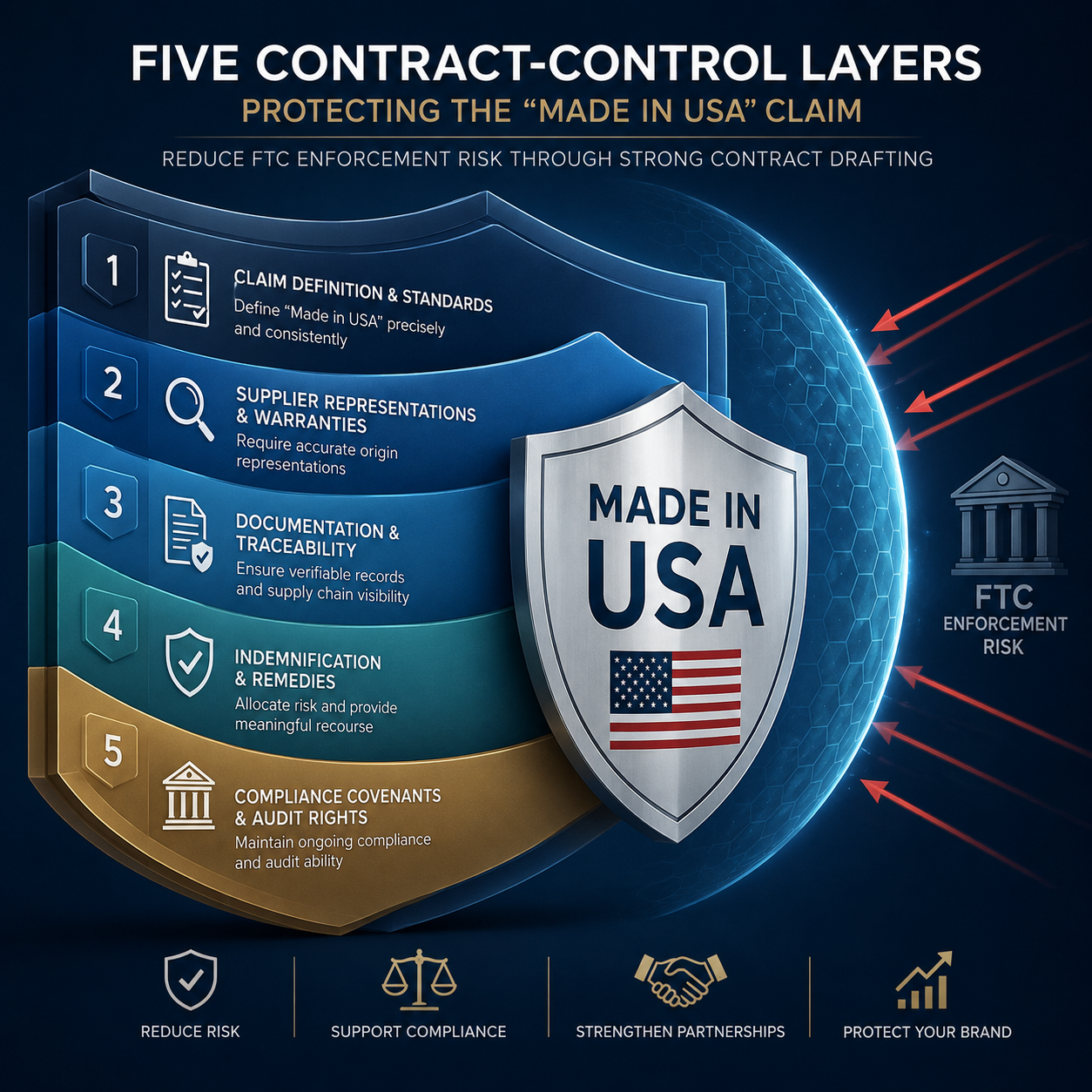
This article provides Counsel with a five-part framework to assess and rework, as needed, their company’s sourcing agreements to tighten gaps concerning its “Made in USA” claims and the respective commercial contracts with its sourcing vendors.
1. Move beyond warranty to indemnity
Many sourcing/supplier agreements contain a general representation that goods will comply with applicable law or that supplier-provided information will be accurate. While these provisions are useful, they may leave the company with only a breach-of-contract claim after the damage has occurred.
A more protective sourcing agreement includes a targeted country-of-origin indemnity under which the supplier defends, indemnifies, and holds the customer harmless from losses arising from inaccurate, incomplete, or misleading country-of-origin information. Covered losses should expressly include regulatory investigations, civil penalties, product withdrawals, recalls or relabeling, corrective advertising, customer claims, reasonable attorneys’ fees, and — where commercially supportable — lost profits and reputational remediation costs.
Counsel should also examine whether the agreement’s limitation-of-liability clause could unintentionally neutralizes the indemnity. A carefully drafted indemnity is of limited value if country-of-origin claims remain subject to a modest general liability cap or an exclusion of consequential damages. Consider a separate or higher cap, or a carveout for supplier fraud, gross negligence, willful misconduct, and material inaccuracies as concerns required country-of-origin sourcing certifications.
2. Mandate trace-back documentation
A supplier’s one-line certification that a product is “domestic” is not the same as substantiation. Contracts should require suppliers to maintain and provide trace-back documentation supporting each country-of-origin claim.
Depending on the product, that documentation may include bills of materials, component-level country-of-origin data, manufacturing and assembly locations, raw-material sourcing records, supplier declarations, customs documentation, and records showing the geographic location of final processing. The obligation should extend through the sourcing supplier’s own upstream supply chain and include verification obligations.
Critically, the contract should require production of these records upon request — not only during a formal audit. Regulatory inquiries and advertising reviews rarely conform to an annual audit schedule. The sourcing agreement should entitle the company to request substantiation documentation before launching a “Made in USA” claim, when onboarding a new SKU, after receiving a complaint, or whenever sourcing facts appear to have changed. The related contract provisions should ensure a short response deadline, documentation accuracy, and an appropriate records-retention period.
3. Expand the manufacturing-change trigger
A domestic-origin claim can become inaccurate quickly if a supplier moves the production of a component, subassembly, or raw material, overseas. Yet many sourcing contracts require notice only when a change affects specifications, quality, or delivery.
The change-control provision should expressly cover country of manufacture, country of assembly, and the source of raw materials and components. Suppliers should provide at least 120 days’ advance written notice — longer where products have extended production cycles — before making such a change.
Prior written notice alone may not be enough. The agreement should prohibit implementation without the customer’s prior written approval when the change could affect a country of origin claim, product labeling, tariff treatment, government-contracting requirement, or other compliance representation. The supplier should identify affected SKUs, purchase orders, inventory, and shipment dates so the customer can determine whether packaging, advertising, certifications, or customer communications must be adjusted.
4. Adjust the audit clause
Audit clauses often focus on pricing, quality systems, or financial records. Counsel should consider adding country-of-origin compliance to the audit scope.
For high-risk or top-tier suppliers, the company should have the right to conduct annual audits and reasonable random spot checks. The audit right should include access to relevant facilities, records, personnel, and upstream supplier certifications, subject to appropriate confidentiality protections. Remote document reviews may be efficient, but the sourcing contracts should preserve the right to conduct an onsite audit when discrepancies arise.
The agreement should also specify which party pays. One practical approach is for the customer to bear routine audit costs but require the supplier to reimburse those costs when an audit identifies a material misstatement, unsupported claim, or repeated documentation failure. The contract should require that the supplier must implement a corrective-action plan within a defined period, at their cost.
5. Rework the rejection remedy
Finally, contracts should convert origin noncompliance into an express product-rejection right. Goods that do not satisfy mutually-agreed domestic-content requirements — or that arrive without required substantiation — should be deemed nonconforming and rejectable without penalty.
The remedy should address logistics before a crisis occurs. The customer should have the right to cancel affected orders, return or quarantine goods at the supplier’s expense, obtain refunds, and require expedited replacement with compliant domestic components or products. Replacement goods should be provided within a pre-negotiated timeline, with no premium pricing, no expedited charges, and no additional freight costs.
In addition, the rejection of nonconfirming goods should not waive indemnification rights or prevent recovery of costs associated with interrupted production, missed commitments, relabeling, or corrective communications. Ideally, the sourcing contract should also preserve additional remedies for the company.
A US$3.175M enforcement lesson for a global retailer
The FTC’s 2024 Williams-Sonoma matter illustrates the stakes. “Williams-Sonoma claimed its products were made in the United States even though they were made in China,” FTC Chair Lina M. Khan said. “Williams-Sonoma’s deception misled consumers and harmed honest American businesses. Today’s record-setting civil penalty makes clear that firms committing Made-in-USA fraud will not get a free pass.”
The FTC sued Williams-Sonoma in 2020, charging that the company advertised multiple product lines under its Rejuvenation, Pottery Barn Teen and Pottery Barn Kids brands as being all or virtually all made in the USA when they were not. The complaint noted that the FTC became aware that the company was marketing mattress pads under its PBTeen brand as “Crafted in America from domestic and imported materials” when they were made in China. The FTC then investigated six other products the company advertised as “Made in USA” and found those claims were also deceptive. The company agreed to pay a record US$3.175 million civil penalty for deceptive Made in USA claims. Although this case predates Executive Order 14392, it demonstrates that deficient country of origin substantiation can result in substantial monetary and compliance consequences.
Closing the sourcing gap
Compliance begins long before a “Made in USA” claim appears on a product label, company website, digital marketplace, or advertising campaign. Whether a company manufactures the product itself or markets and sells products sourced from third parties, substantiating a domestic-origin claim requires early collaboration among product development, sourcing, supply chain, quality, marketing, legal, and compliance teams. Those teams must ensure that origin-related data is accurate, traceable, and adequately documented, while supplier and sourcing agreements allocate responsibility for the accuracy of country-of-origin information and provide the rights necessary to obtain, verify, and rely upon the supporting documentation.
Closing the sourcing gap will help to ensure that every “Made in the USA” claim can withstand scrutiny, protecting the company from enforcement action while preserving customer trust.
Disclaimer: The information in any resource in this website should not be construed as legal advice or as a legal opinion on specific facts, and should not be considered representing the views of its authors, its authors’ employers, its sponsors, and/or ACC. These resources are not intended as a definitive statement on the subject addressed. Rather, they are intended to serve as a tool providing practical guidance and references for the busy in-house practitioner and other readers.