Banner artwork by elenabsl / Shutterstock.com
Consider a hypothetical megacorp called Northline. Northline is a publicly traded North American manufacturer and distributor with ten thousand employees, several plants, and an insatiable appetite for acquisitions.
When initiated, the board-approved enterprise AI strategy included AI data governance. Northline's Vice President of Enterprise Data, Dan Merrick, built the program. With twenty years of experience, he built it by the book.
Merrick chartered a governance committee with legal, risk, privacy, and the business units represented. His four-tier data classification standard was ratified. He licensed a catalog, named data stewards across business units, and classified the systems in scope. He published an acceptable use policy for generative AI, stood up an approved enterprise platform with contractual protections on confidentiality and training, and blocked the consumer tools at the perimeter. He built a model inventory and a register of approved use cases. An internal audit team reviewed the program and found it sound. Merrick presented it to the executive team. Everyone left that meeting confident that Northline had AI data governance handled. The three-year program was a resounding success. A well-earned celebration was planned and Merrick was promoted. He left behind all the documentation, the charter, the processes, and the committee schedules. His replacement was trained and feeling confident she could handle picking up where Merrick left off.
Merrick had spent a career handing work off, and he handed this off just the same. The program's continued effectiveness rested on the conscientiousness of whoever held the role.
After Merrick moved on, the governance committee met only a few more times. Two of the data stewards left the company without replacement, their names staying in the catalog erroneously. A recent acquisition brought its own ERP, its own CRM, and years of engineering data that were never itemized against the classification standard.
Northline has an abundance of data, a robust IT and security team, including a Chief Data Officer, Chief Information Officer, Chief Information Security Officer, Privacy Officer, and a Chief Risk Officer. As is common in large companies, each executive operates in a silo. There is little intersection, and none are obliged to report on Merrick's program within their departments.
So nobody did.
A major customer sent a questionnaire ahead of its contract renewal seeking assurance that Northline had an active AI data governance model.
Merrick's program was presumed to have this covered and the completed questionnaire, signed by Northline's General Counsel, and governance charter were sent to the customer.
After six weeks of silence, the customer exercised its audit rights to review the data inventory behind Northline's AI tools. The request got passed around a handful of inboxes and Northline could not produce one.
The customer paused the renewal, surprised that Northline's General Counsel had signed the attestation when the company could not produce the data inventory.
State of the Union
ACC's 2026 Chief Legal Officers Survey draws on responses from 1,049 CLOs across 43 countries. A single theme tracked through all responses: in-house legal is changing rapidly.
A record 84 percent of CLOs now report directly to the CEO. Roughly half also hold a direct reporting line to the board. Compliance and privacy commonly report to the CLO, and a growing number of CLOs carry a second title such as chief risk officer or corporate secretary.
On AI, 47 percent of CLOs say their CEO now expects them to develop technology and AI proficiency, and 36 percent of legal departments are in active deployment of generative AI. CEOs are pushing AI proficiency for increased productivity and decreased legal costs. Critically, this proficiency push is typically not paired with one for AI data governance.
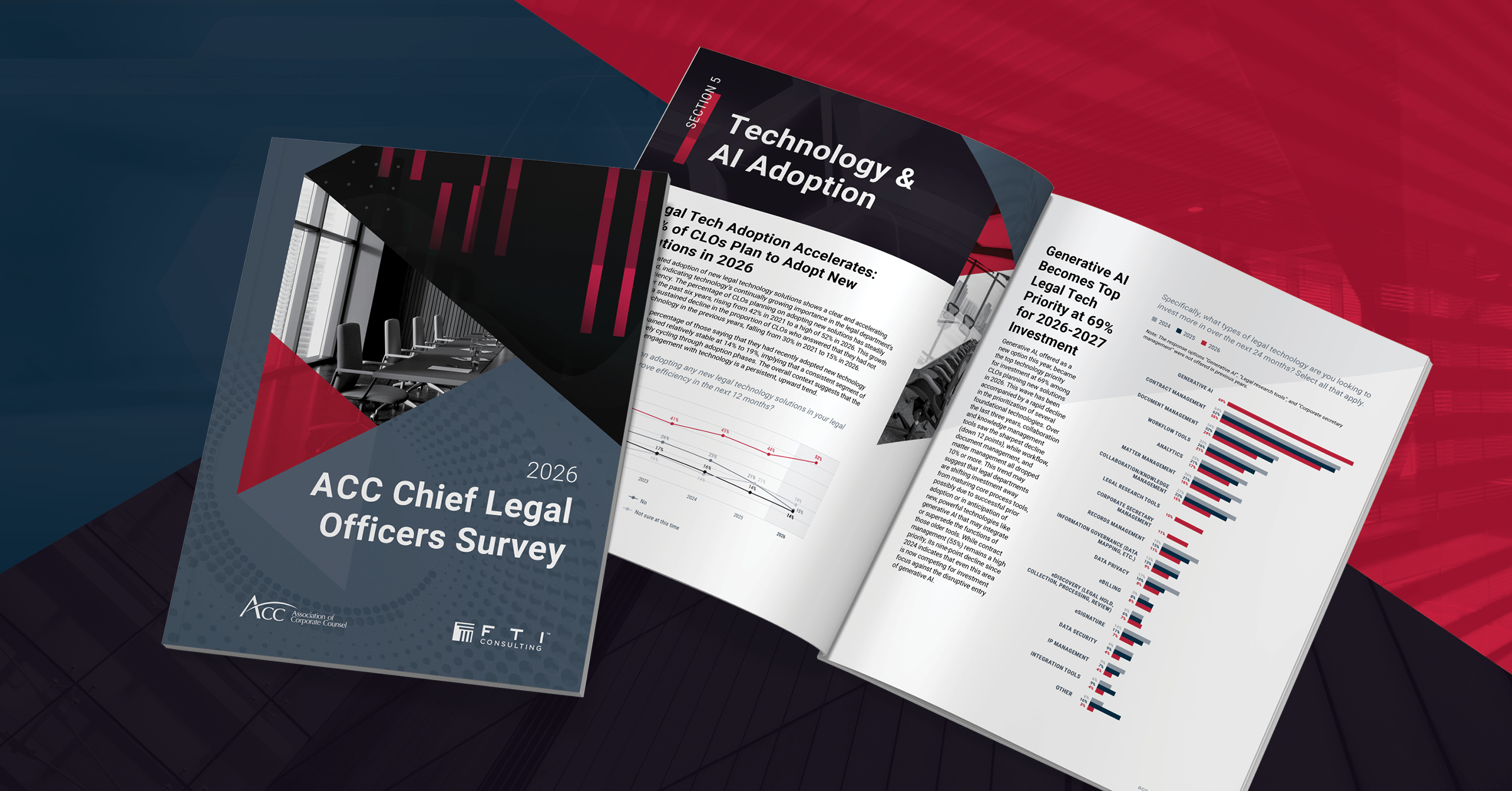
CEOs are pushing AI proficiency for increased productivity and decreased legal costs. Critically, this proficiency push is typically not paired with one for AI data governance.
These numbers highlight the uphill battle at the heart of this article. High-functioning AI data governance requires someone who (a) sits at the CEO's table, (b) holds a line to the board, and (c) reports on a cadence to the departments that touch the data. The data show that CLOs and their departments increasingly occupy this position.
The problem is that the directives to CLOs remain proficiency in using AI, not ownership of AI data governance. Ownership is about whether (a) the company still has the rights it thinks it does, (b) the classification standard still covers what it claims to, and (c) anyone is still obliged to say so on a schedule. Each a different job.
The problem is that the directives to CLOs remain proficiency in using AI, not ownership of AI data governance.
In May 2026, the American Arbitration Association published a survey based on responses from 500 senior legal and executive leaders at large US and Canadian organizations, finding that many organizations are struggling to turn AI governance policies into systems that work in practice. The survey shows authority and control over AI mostly sit with technology leadership. As the AAA put it: "Legal and compliance teams are not consistently involved. While 80 percent say IT or technology teams contribute to AI governance, only 35 percent report involvement from legal and compliance teams." This article argues that authority over operational AI systems is not authority over ongoing governance, and that gap needs to be addressed.
The surveys are not at fault for this gap; they reflect the current state of the union.
Redrawing the lines
Calling legal "the department of no" is so common it has become a corporate cliché, and legal largely earned it. In-house counsel roles nearly doubled between 2008 and 2024, outpacing growth at law firms and the public sector. As attorneys moved inside the business, the clean line between client and counsel blurred. A business takes risks to grow. The lawyer's job is to protect it. This inherent conflict has grown too.
A business takes risks to grow. The lawyer's job is to protect it.
Legal departments are currently inundated with AI policy drafting and review, and constant questions about AI contract provisions and employment practices. When leaders think "who do I need to ask if we are allowed to do this," they (should) think of Legal. Legal and IT have worked together before, on SOX controls, e-discovery, and GDPR. In each case, legal advised and IT owned the program. AI data governance matures that relationship. Legal owns the program and IT runs it. The challenge is ensuring companies give proper weight to each role in the age of AI.
Back to Northline.
Northline has a GC named Claire. She reports to the CEO, sits in on board meetings, and her workflows include: commercial contracts, privacy, litigation, employment matters, and IP. Claire blesses every Northline contract, including the now-paused renewal. Every acquisition lands on her desk before it closes and she leads the post-closing cleanup. What she doesn't touch is Merrick's program or any of the program's key questions: what data Northline holds, whose rights attach to it, what obligations came with it, what retention applies, and what has to be disclosed. These are legal questions, but the program was chartered as an IT initiative, and nothing was set up to route them to her.
Take the recent acquisition's engineering data, years of which were never itemized against the classification standard. The controlling factors as to what data can be used by AI do not live in the same data storage as the information itself. These factors are set forth in the purchase agreement, the licenses, and the law governing such data. Neither Merrick nor his successor can reach these answers. Claire either already knows the answer or where to find it.
Because the questionnaire came attached to a contract renewal, it went to Claire. She read the charter, saw a ratified standard, a chartered committee, a catalog, and a clean internal audit, and so she affirmed the program was in place and functioning.
Merrick built the program by the book, his successor inherited it in good faith, and Claire relied on documents that had been accurate when written. No one owned the job of keeping the program running. Claire had no mandate to check it and no reports that would have told her it had stopped.
Redefining AI data governance ownership
Northline's program did not need a better operator. It needed to go to the GC.
Legal would not have been more diligent than Merrick's replacement. Legal's obligations attach to the role rather than to a project. Legal already reports to leadership and the board on litigation and compliance on a schedule. AI data governance belongs in those reports. Legal can also answer the questions AI data governance turns on: whether the company holds the rights it thinks it holds, and what it can defend if challenged.
The CDO knows what data Northline holds and where it lives. The CISO knows who can reach it. Neither can say whether Northline has the right to use it for AI, because that answer lives in contracts, licenses, consents, and law. That question belongs to Legal, and so does the obligation to attest to it.
Two factors matter here, and most organizations miss both.
The best Northline can do now is loop in Legal late. The CLO should have been in the room when the program was first being discussed. Mobley v. Workday shows why. In May 2026, a federal magistrate judge ruled that Workday's bias-testing data was privileged because its lawyers chose the data and directed the testing to provide legal advice. Early, substantive involvement by counsel can protect the work itself. Bringing legal in only after a problem surfaces is usually too late.
The responsibility also has to be written into the role rather than into a program charter. A charter attaches to a project and dies with its sponsor, which is what happened at Northline. A responsibility written into the CLO's mandate attaches to the chair, appears in what the board expects to hear about, and survives whoever holds it. Companies such as Shopify and parts of Microsoft now count AI use in performance reviews. AI data governance should count the same way in how the CLO's performance is measured.
AI data governance should count the same way in how the CLO's performance is measured.
Legal has to be involved from the beginning. A technology leader who has legal training or who has delivered against legal governance obligations before (an e-discovery collection, a records retention schedule, or a set of controls evidenced for an auditor) knows what legal needs. Those leaders naturally work with legal while the program is being built. Such an IT professional is rare. Most have never had to consider early collaboration with legal; they have spent their careers transitioning systems to operations teams. AI has changed what is required of an effective IT executive. These professionals now need to understand enough of the legal department's perspective to work together successfully.
The following five best practices define a collaborative approach for legal and IT teams ensuring successful corporate AI governance initiatives:
- Determine rights. Whether the company holds the right to use a given class of data in a given way, read out of contracts, licenses, consents, and law, with the basis recorded. IT owes the lineage that makes the question answerable.
- Own the classification standard and its consequences. Legal defines the categories and what each one permits and forbids. IT applies the labels at scale, implements the controls, and reports coverage.
- Direct the assessment work that carries legal consequences. Bias testing, rights review, and impact assessment, with counsel curating the data and setting the purpose. IT runs the tests and produces the evidence.
- Certify on a cadence. A named certification to the audit committee stating current coverage, what has drifted, and what now sits outside scope. IT owes the telemetry that makes the certification factual rather than aspirational. This is the obligation Northline never had, and it is the one that keeps the other four from eroding.
- Extend retention and hold to model artifacts. Embeddings, vector indexes, prompt logs, and caches, not only the source tables. Legal sets the schedule and issues the hold. IT executes across all of it and confirms completion.
This adds work, and budget is already a top barrier in the ACC survey. Much of that work already sits in Legal: contract review, M&A diligence, and litigation holds.
Any one of the five points above would have improved Northline's experience. Northline's execution was textbook and flawless according to the pre-AI approach. In this new age the requirements for successful governance have changed, and that means ensuring operational data governance obligations have the proper owners.
If your company has invested in AI data governance, ask who vouches for it, and whether that person has the authority, the cadence, and the evidence to know it still works.
Cases and Orders
Mobley v. Workday, Inc., No. 23-cv-00770-RFL (LB) (N.D. Cal. May 28, 2026), Magistrate Judge Laurel Beeler. Held that Workday's internal AI bias-testing data was protected by attorney-client privilege because its attorneys curated the data used in the testing and the purpose was to obtain legal advice on New York City Local Law 144 compliance. Privilege turned on counsel directing the selection and curation of data rather than reviewing technical results afterward. Disclosing that bias testing existed did not waive it. Workday's own EEO-1 and OFCCP records were ordered produced.
Artificial Intelligence Disclaimer
Consistent with the transparency this article encourages, the authors note that they used Claude to assist with drafting, editing, and citation research.
Disclaimer: The information in any resource in this website should not be construed as legal advice or as a legal opinion on specific facts, and should not be considered representing the views of its authors, its authors’ employers, its sponsors, and/or ACC. These resources are not intended as a definitive statement on the subject addressed. Rather, they are intended to serve as a tool providing practical guidance and references for the busy in-house practitioner and other readers.