
Banner artwork by Susan 78 / Shutterstock.com
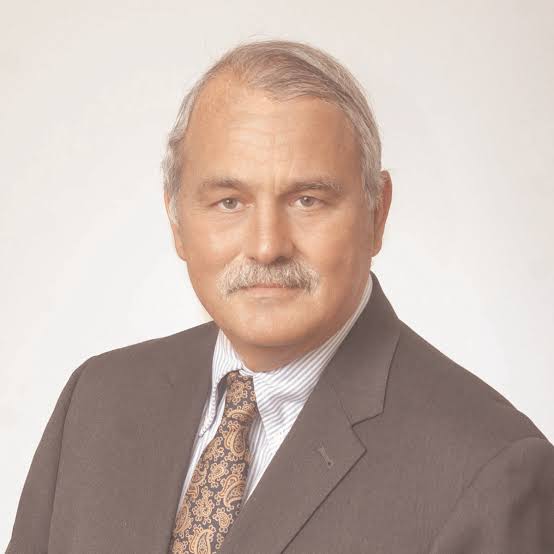
Thomas L. "Tom" Sager, the former DuPont general counsel who changed how corporate legal departments work with their law firms, died at home in Bethany Beach, Delaware, on September 14, 2026, after a long battle with dementia. He was 76.
To the in-house bar, Sager was more than a successful general counsel. He was a builder: of a legal model the profession still studies; of organizations that opened doors for diverse lawyers; and of careers. Newer members of the legal community may not know his name, but they know his work, whether they realize it or not. Colleagues remember a man who reached the top of one of America's oldest companies and never stopped making time for the people around him.
“Tom was a true legend of a lawyer,” said CPR board member Stephen Younger, Senior Counsel at Withers Worldwide. “His legacy included both encouraging the hiring of lawyers from varied backgrounds and promoting alternative methods of dispute resolution. He made a real difference in our profession.”
Where he came from
Born in 1950 in Winchester, Massachusetts, and raised in Warwick, Rhode Island, Sager studied at the University of North Carolina and Wake Forest University School of Law. He joined DuPont as a labor lawyer in 1976 and spent 37 years there, retiring as senior vice president and general counsel before joining Ballard Spahr.
The man behind the title
Ask the people who worked with Sager what they remember about the GC, and few start with the DuPont Legal Model. They talk about how he made them feel. Colleagues describe him as humble and down to earth, a man who gave a junior lawyer the same respect and attention as a senior partner. “Tom brought the legal acumen, strategic vision, and bold commitment to fairness and justice that helped push the legal profession closer to its highest ideals,” said Damon Hewitt, President and Executive Director, of the Lawyers’ Committee for Civil Rights Under Law.
Above all, he was a mentor. Lawyers who worked for him say he saw their potential before they did, handed them assignments that stretched them, and kept nudging them past their comfort zones. He expected them to give back, too, gently insisting they join nonprofit boards and stay active in their communities.
His kindness often showed up in quiet, private ways. Former team members recall his steady hand through hard times, his good humor, and loyalty that never depended on rank. None of it was for show, and none of it came with strings. It was simply how he moved through the world.
The DuPont Legal Model
Sager’s best-known achievement is the DuPont Legal Model, which has transformed corporate law. In the early 1990s, most companies spread their legal work across hundreds of firms and simply paid the bills. He asked a question that few general counsel were asking at the time: what are we actually getting for this?
The answer was convergence. DuPont cut its roster from roughly 350 outside firms to 34 primary law firms, gave those firms more of its work, and taught them its business so they could advise it better. Value-based fees, early case assessment, budgets and metrics for legal work, diversity expectations for outside counsel: ideas that sound routine today were genuinely new then, decades ahead of most of corporate America.
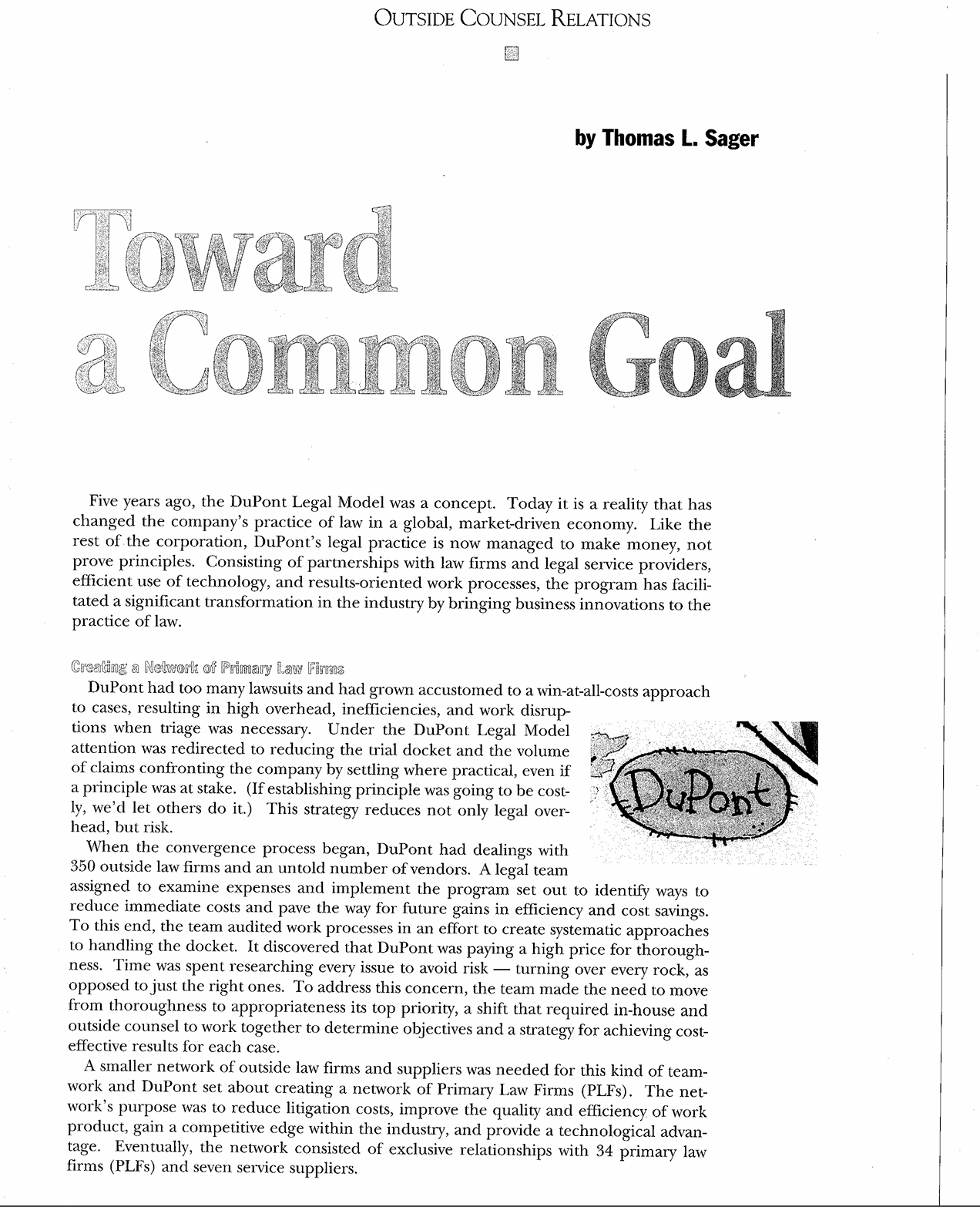
He made the case himself in the July 1997 issue of the ACC Docket. In "Toward a Common Goal," he described a law department that had grown used to fighting every case to the end, and how it learned to settle where that made sense and stop paying to research every possible issue. The aim, he wrote, was to move "from thoroughness to appropriateness," with in-house and outside counsel agreeing together on the objective for each matter. The results were striking — legal spending fell from about $200 million in 1994 to a forecast of $127.5 million in 1997, and case cycle time dropped from 39 months to 22. For Sager, the model was never only about cutting costs. It reflected what he believed: that outside lawyers should be trusted partners invested in the client's success, that good work deserved fair reward, and that the firms DuPont hired should reflect the diversity of the world it served. His strategy put greater involvement of women and minorities right alongside cost and technology. And he never kept any of it to himself, treating the model less as a competitive edge than as a gift to the profession.
"He was looking at ways to make sure that his law department, and also the firms he chose to be part of the DuPont legal network, were really about creating opportunities and leveling the playing field. He was mindful of who was doing his work," said Veta T. Richardson, former ACC President and CEO.
Opening doors for others
As much as the DuPont Legal Model defined his career, the work Sager was proudest of may have been making the profession look more like the world it serves. He treated diversity as a business standard, not a slogan. He recognized the barriers facing women, minority, and LGBTQ lawyers. He built a broad tent within his own department and paid attention to who was actually doing DuPont's work at its outside firms. He pressed these points in the late 1990s, as a white man at the top of a major corporation, when staying quiet would have been far easier. That is part of what made him so influential.
In 1997 he helped found the Minority Corporate Counsel Association (MCCA), later serving on its board and as its chairman. That same year MCCA created the Thomas L. Sager Award, presented annually to law firms with a sustained record of hiring, retaining, and promoting minority attorneys. After retiring, he gave $50,000 to MCCA to support its mission.
He also urged in-house lawyers to take on pro bono work, at a time when many saw that as a job for law firms. He was among the lawyers invited to the White House as part of Lawyers for One America, an effort to expand access to legal counsel for people who could not afford it, and to widen opportunity for diverse lawyers across the profession. He later co-chaired the board of the Lawyers' Committee for Civil Rights Under Law.
A friend to ACC
Sager was one of the general counsel who supported ACC as it grew into a global organization. With DuPont selling its products around the world, he understood earlier than most that in-house lawyers needed an association that crossed borders. He also championed stronger collaboration between corporate legal departments and outside law firms and understood that legal departments should be viewed not as cost centers, but as strategic contributors to business success, a principle that became central to ACC's mission.
"Tom was instrumental in redefining the relationship between in-house counsel and outside counsel, to be more collaborative and focused on adding value to the corporation," added Richardson on his impact.
Sager served on the ACC Board of Directors from 2000 to 2002, bringing the perspective of a general counsel who was already reshaping how legal departments operated.
“I only had the opportunity to meet Tom once, but I had long respected and revered him as one of the great leaders of our profession. His commitment to inclusion was not simply something he spoke about — it was reflected in the opportunities he created and the doors he opened for others. His leadership helped make the legal profession better, stronger, and more inclusive." said Jason L. Brown, ACC President and CEO.
A lasting legacy
Sager’s impact is measured less in policies than in people. Convergence changed the economics of corporate legal work, but its deeper lesson was that clients and law firms do better as partners than as adversaries. The Sager Award has spent nearly three decades rewarding firms that open their ranks to minority lawyers. And a generation of general counsel, litigators, and law firm leaders — many of them women and lawyers of color — can trace their careers to a door he held open.
What he stood for never wavered: excellence paired with fairness, and the conviction that lawyers with power have a duty to widen the path for others. Colleagues remember that he backed his words with action, often when doing so carried real risk.
He served his community too, on the boards of the Delaware Chapter of the American Red Cross, the Delaware Community Foundation, and Widener University School of Law.
Every in-house lawyer who negotiates a value-based fee, holds outside counsel to diversity commitments, or takes on a pro bono matter is working in a profession Tom Sager helped shape. He showed us what a general counsel could build, and, more than that, what kind of person a general counsel could be. ACC is grateful for his leadership and friendship.